“`html
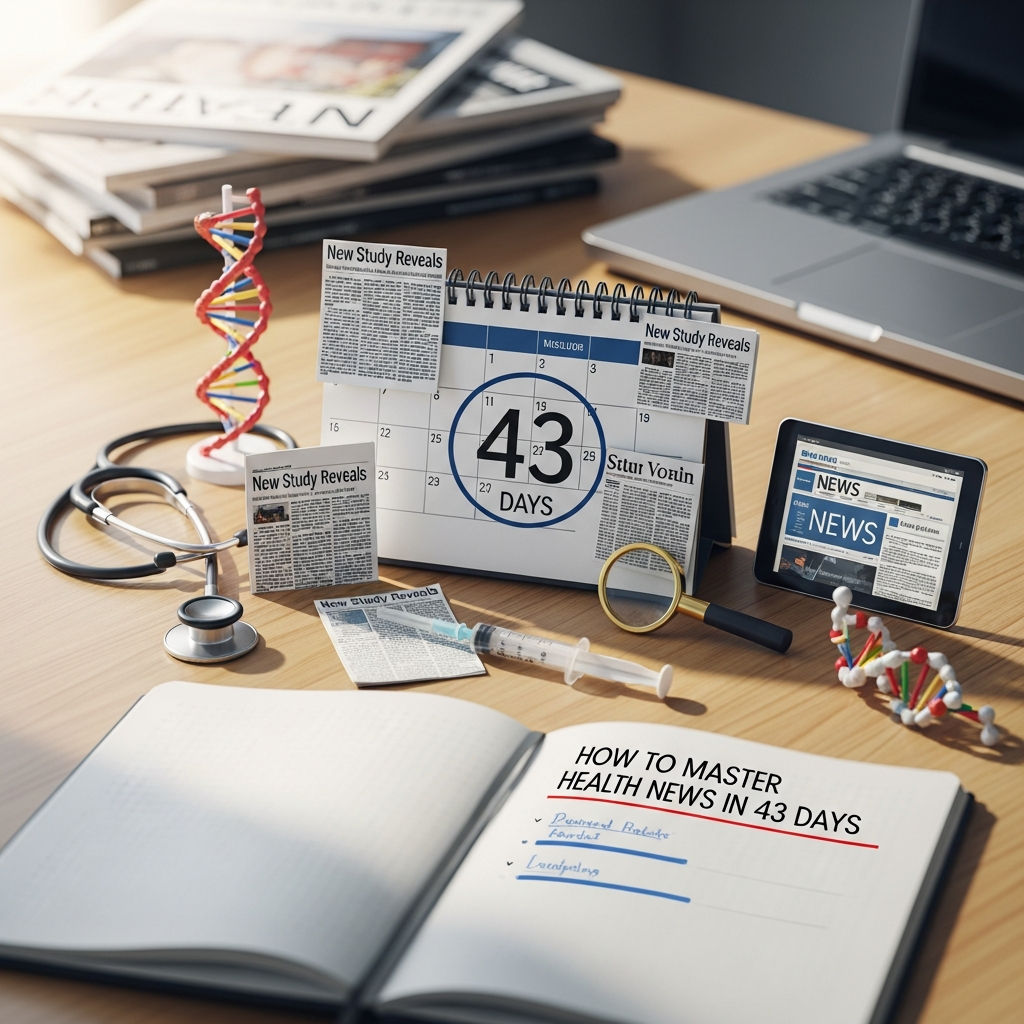
How to Master Health News in 43 Days: A Comprehensive Guide
In an era defined by the “infodemic,” staying informed about health and wellness has never been more critical—or more confusing. Every day, headlines oscillate between miracle cures and dire warnings, often citing the same scientific studies. For the average person, this constant stream of information can lead to “health news fatigue.” However, health literacy is a skill that can be developed. By following a structured 43-day roadmap, you can transform from a passive consumer of clickbait into a savvy navigator of medical research and wellness trends.
Why 43 days? Behavioral science suggests that it takes approximately six weeks to solidify complex cognitive habits. This timeframe allows you to move beyond surface-level reading and develop the critical thinking skills necessary to distinguish between breakthrough science and marketing hype. Here is your step-by-step guide to mastering health news.
Phase 1: Building the Foundation (Days 1–10)
The first ten days are about learning the language of health news. You cannot interpret a story if you don’t understand the framework of the research behind it.
Mastering the Vocabulary
Start by familiarizing yourself with key terms. Health news often revolves around specific study designs. You must understand the hierarchy of evidence:
- Meta-Analysis & Systematic Reviews: The gold standard; these look at multiple studies to find a consensus.
- Randomized Controlled Trials (RCTs): The best way to determine cause and effect.
- Observational Studies: These show correlations but cannot prove one thing caused another.
- Animal and In-Vitro Studies: Fascinating, but rarely directly applicable to humans without further testing.
The Goal of Phase 1
Spend these first ten days reading one medical abstract per day on a site like PubMed or Google Scholar. Don’t worry if you don’t understand every word; focus on identifying the “Study Design” and the “Conclusion.” By day 10, you should be able to spot the difference between a study that suggests a trend and one that proves a result.
Phase 2: Developing Critical Thinking (Days 11–20)
Once you know the terms, you need to learn how to spot “red flags.” This phase is about developing a healthy skepticism toward sensational headlines.
The Correlation vs. Causation Trap
Most health news “scares” come from observational studies. For example, a headline might claim, “Drinking coffee leads to a longer life.” In reality, the study might only show that coffee drinkers *happen* to live longer, perhaps because they have more disposable income or better healthcare. On days 11–15, practice questioning every headline by asking: “Is this a link or a cause?”
Understanding Relative vs. Absolute Risk
This is where many journalists mislead readers. A headline might say, “New drug increases heart attack risk by 50%!” This sounds terrifying. However, if the absolute risk increases from 2 in 1,000 to 3 in 1,000, that is a 50% *relative* increase but a very small *absolute* increase. Learning to look for the raw numbers will prevent unnecessary panic.
Checking the Sample Size
A study involving 10 people is a pilot; a study involving 10,000 people is a trend. During days 16–20, look at the “N” (the number of participants) in every news story you read. If the sample size is small, take the findings with a grain of salt.
Phase 3: Navigating Sources and Bias (Days 21–30)
Not all news outlets are created equal. In this phase, you will curate your “Information Diet.”
Identify Reputable Sources
Move away from general tabloids and toward specialized health publications. Create a bookmark folder or a feed (like Feedly) with the following types of sources:
- Primary Journals: The New England Journal of Medicine (NEJM), The Lancet, and JAMA.
- Science Communication Sites: STAT News, ScienceDaily, and Kaiser Health News (KHN).
- Academic Centers: Mayo Clinic, Harvard Health Publishing, and Johns Hopkins Medicine.
Follow the Money
On days 25–30, focus on finding the “Conflicts of Interest” section in studies. If a study claiming sugar is healthy is funded by the soda industry, the results are compromised. True mastery of health news requires understanding that science is a human endeavor influenced by funding and career incentives.
Phase 4: Synthesis and Application (Days 31–43)
The final phase is about putting your knowledge into practice. You are no longer just reading news; you are synthesizing it to make better life decisions.
Cross-Referencing News
When you see a major health story break (e.g., a new diet trend or a vaccine update), don’t rely on one source. Compare how the New York Times, a medical journal, and a specialized health blogger cover the same topic. Notice what details are included—and more importantly, what is left out.
Building a Feedback Loop
During these final days, start a “Health News Journal.” Write down one piece of health news you encountered and analyze it based on your new skills:
- What was the study design?
- Was the sample size sufficient?
- Is the headline sensationalized?
- Who funded the research?
Becoming an Active Participant
By day 43, you should feel comfortable discussing health news with your physician. Instead of saying, “I read that eggs are bad for me,” you can say, “I saw a recent observational study in JAMA regarding dietary cholesterol; how does that apply to my specific lipid profile?” This level of health literacy changes the dynamic of your healthcare from passive to collaborative.
The Long-Term Impact of Health Literacy
Mastering health news in 43 days isn’t just about winning arguments at the dinner table; it’s about mental and physical well-being. Misinformation can lead to “nocebo” effects (where you feel sick just by worrying) or lead you to waste money on ineffective supplements and dangerous fad diets.
By the end of this 43-day journey, you will have developed a “filter” that automatically screens out low-quality information. You will recognize that science is a slow, iterative process rather than a series of daily “miracles.” This perspective fosters a sense of calm and empowerment in a world that often uses health fears to drive clicks.
Key Takeaways for Your 43-Day Journey:
- Stay Curious, Not Fearful: Most health news is designed to grab attention, not provide medical advice.
- Check the Date: Medical science moves fast; a “breakthrough” from five years ago might have already been debunked.
- Look for Consensus: One study is never the final word. Look for a body of evidence.
- Consult Professionals: Use your news mastery to ask better questions of your doctor, not to replace them.
Mastering health news is a lifelong journey, but these 43 days will provide the foundational armor you need to navigate the modern media landscape with confidence and clarity.
“`
About the Author